
GEODES@MODELS2026
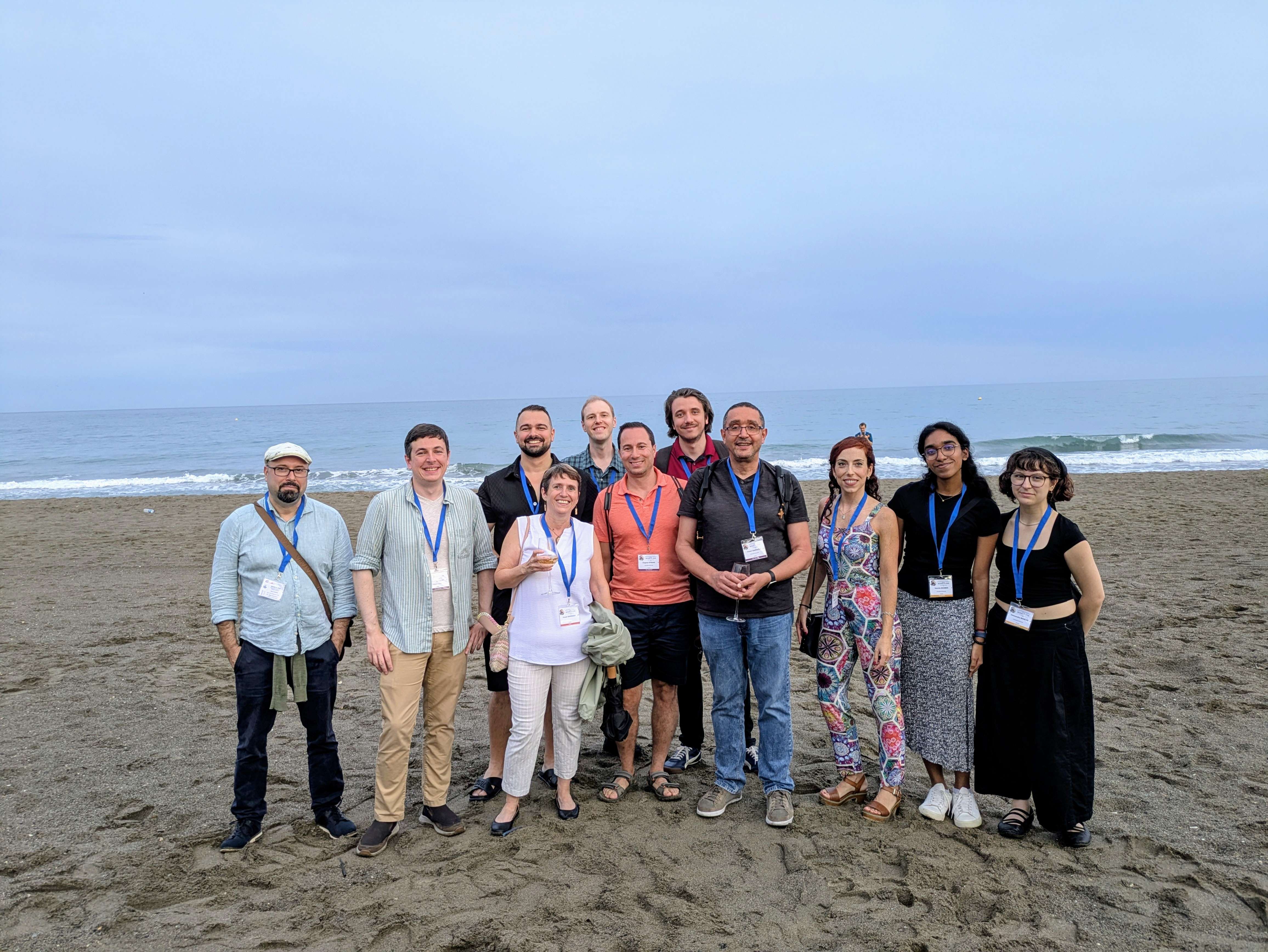
This October, MODELS 2026 brought the model-driven engineering community to Málaga, Spain, from October 4 to 9. GEODES was represented throughout the week, from the co-located workshops and conferences to the main research program.
Rethinking consistency in collaborative modeling
The week started on Sunday with Luciano Marchezan presenting “Towards Rethinking Consistency Management in Collaborative Modeling Through Organizational Dimensions”, co-authored with Hyacinth Ali and Eugene Syriani. His presentation appeared in the Models and Evolution workshop.
The paper looks at consistency management from a perspective that goes beyond detecting and fixing differences between models. When people model together, the right strategy also depends on how their team works: who owns which artifacts, who can make decisions, and whether temporary inconsistencies are acceptable. The work proposes using these organizational dimensions to guide the choice of consistency-management strategies.
DOI: 10.1145/3837062.3838722.
A Model-Driven Formalization of Prompt Patterns
On Monday, Vennila Sooben presented “A Model-Driven Formalization of Prompt Patterns”, co-authored with Eugene Syriani, at the MDE Intelligence workshop. Her contribution connected the workshop’s two themes by applying model-driven engineering to the formal representation of prompt patterns.
DOI: 10.1145/3837062.3839377.
Digital twins for greenhouse crop production
MODELS week also included EDTconf 2026, the International Conference on Engineering Digital Twins. In its SoSyM Journal Track, Kevin Delcourt presented “Trans-Domain Digital Twins with Adaptive Intelligence for Optimizing Greenhouse Crop Production”, co-authored with Mansoorali Amiri and Houari Sahraoui.
The paper brings together two closely connected parts of greenhouse farming: the plants and their environment. Its digital twin architecture connects crop and greenhouse models through synchronized co-simulation, while an alignment layer handles differences between the models. Simulations provide estimates of conditions that physical sensors cannot fully capture, and adaptive data-driven components support prediction and control. The goal is to move beyond isolated models toward a digital twin that represents how plant growth, microclimate, and control decisions affect one another.
The paper was published in Software and Systems Modeling (SoSyM) in September 2026. DOI: 10.1007/s10270-026-01434-1.
Breaking Models to Test the Judge
Kevin also presented “Breaking Models to Test the Judge: A Mutation Testing Approach for Semantic Evaluators of Domain Class Diagrams” in the New Ideas and Emerging Results (NIER) track. The paper was co-authored with Meriem Ben Chaaben, Abdelhamid Rouatbi, Luciano Marchezan, and Houari Sahraoui.
The work asks a question that becomes increasingly important as LLMs are used to evaluate models: how do we test the evaluator? The approach deliberately introduces semantic errors into domain class diagrams and checks whether an LLM-based judge detects them. By comparing these mutation-based evaluations with manual assessments, the paper explores a more systematic way to assess the reliability of semantic judges.
DOI: 10.1145/3822455.3838768.
Towards Lightweight Domain Model Reverse Engineering from Source Code
In the main conference’s Research Papers track, Alessandra Mancas presented “Towards Lightweight Domain Model Reverse Engineering from Source Code”, co-authored with Mounir Ammam, Hyacinth Ali, Kevin Delcourt, and Houari Sahraoui.
The paper tackles a familiar reverse-engineering problem: source code contains many implementation details, but understanding a system often requires recovering the higher-level concepts of its domain. The approach combines structural and semantic heuristics with lightweight, open-source LLMs to identify those concepts and their relationships. Rather than feeding an entire codebase to a large model, it selects and processes relevant information incrementally, with local deployment and limited context windows in mind.
DOI: 10.1145/3822455.3830329.
Ten years of influence
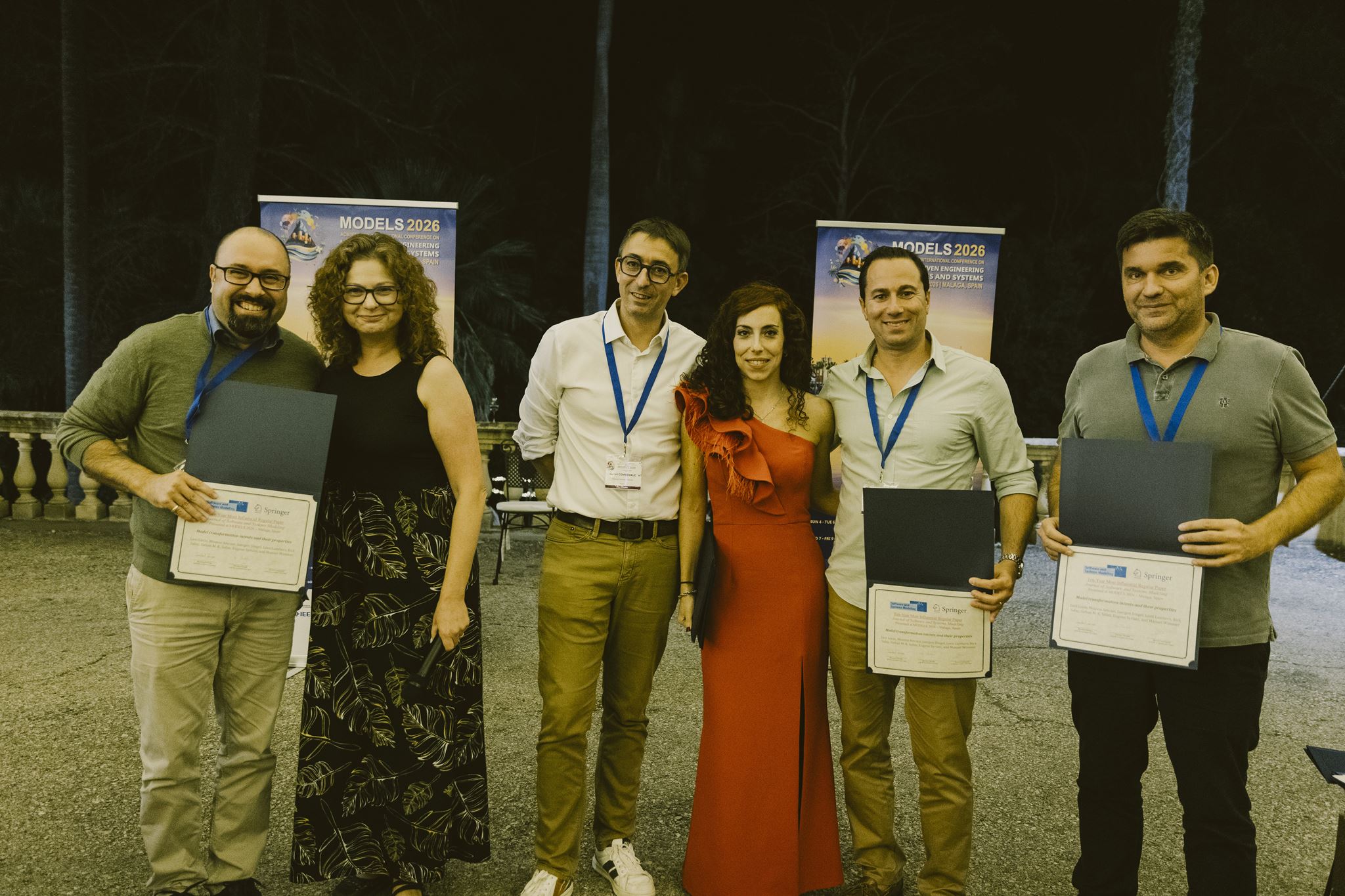
The week also provided an opportunity to revisit research whose influence has lasted a decade. In the conference’s SoSyM awards session, Eugene Syriani presented “Model transformation intents and their properties”, co-authored with Levi Lúcio, Moussa Amrani, Juergen Dingel, Leen Lambers, Rick Salay, Gehan M. K. Selim, and Manuel Wimmer.
The paper received the 2026 SoSyM Ten Year Most Influential Regular Paper Award. It examines model transformations through their intent: what a transformation is meant to accomplish, and which properties it should satisfy to fulfill that purpose. This perspective provides a framework for reasoning about transformations beyond their individual implementations.
The paper appeared in Software and Systems Modeling, Volume 15, Issue 3 (2016), pp. 647–684. DOI: 10.1007/s10270-014-0429-x. Congratulations to Eugene and all his co-authors!
A Student Research Competition
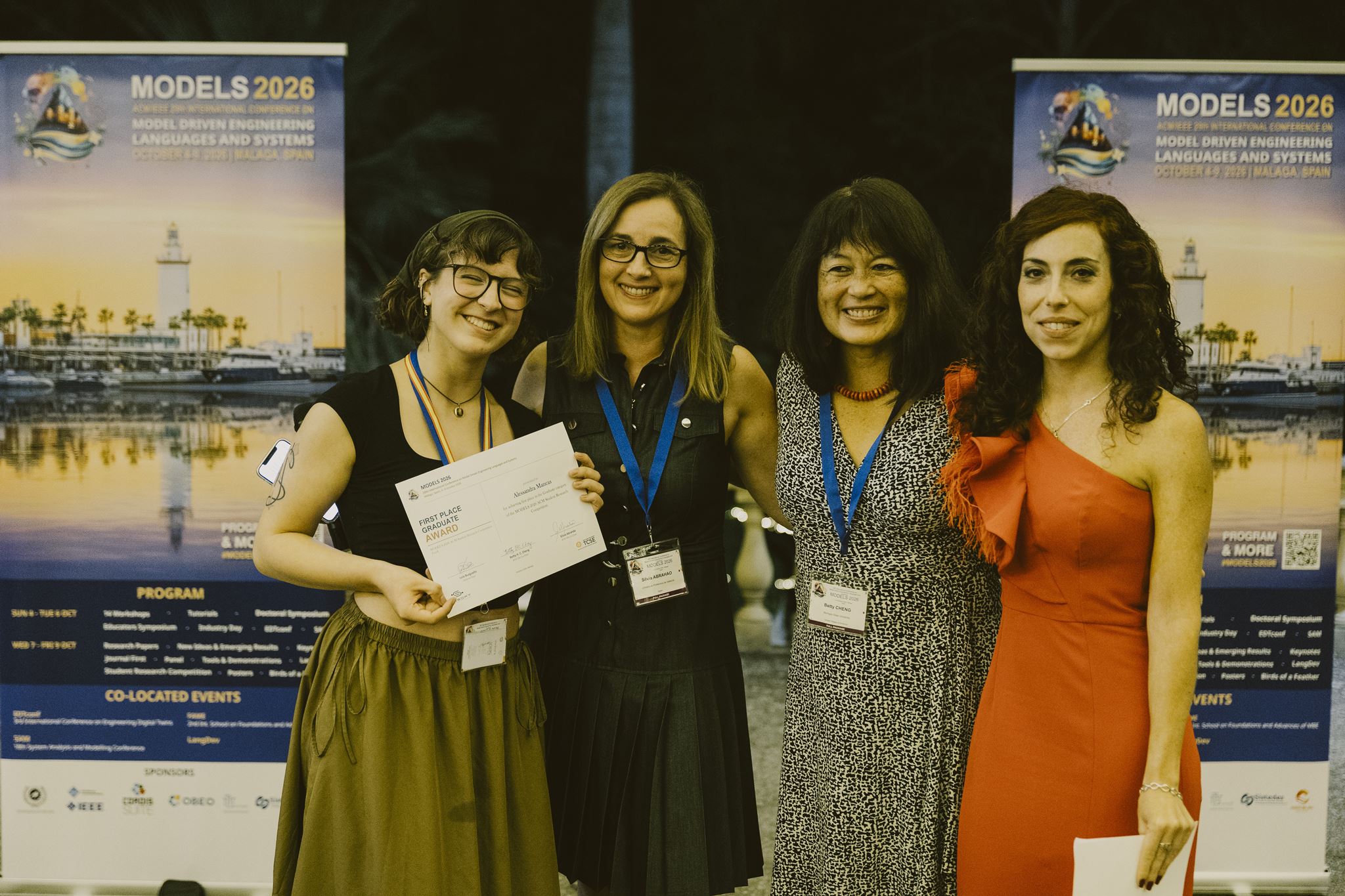
One of the highlights of the week for us was the ACM Student Research Competition. In addition to her main-track presentation, Alessandra presented “A Modular Framework for Conceptual Model Recovery from Source Code” in the graduate competition, taking part in both the poster and presentation rounds.
Her project separates the extraction of implementation information from the recovery of higher-level meaning, using structured intermediate representations to connect the two. The framework is illustrated through domain model recovery and conceptual sequence diagram recovery, exploring how different reverse-engineering tasks can share a common approach.
Alessandra won 1st place! Following Imen Jaoua’s first place at FSE 2026, this gives GEODES two finalists in the ACM SRC Grand Finals.
The SRC paper appears in the MODELS 2026 Companion Proceedings. DOI: 10.1145/3837062.3839353.